
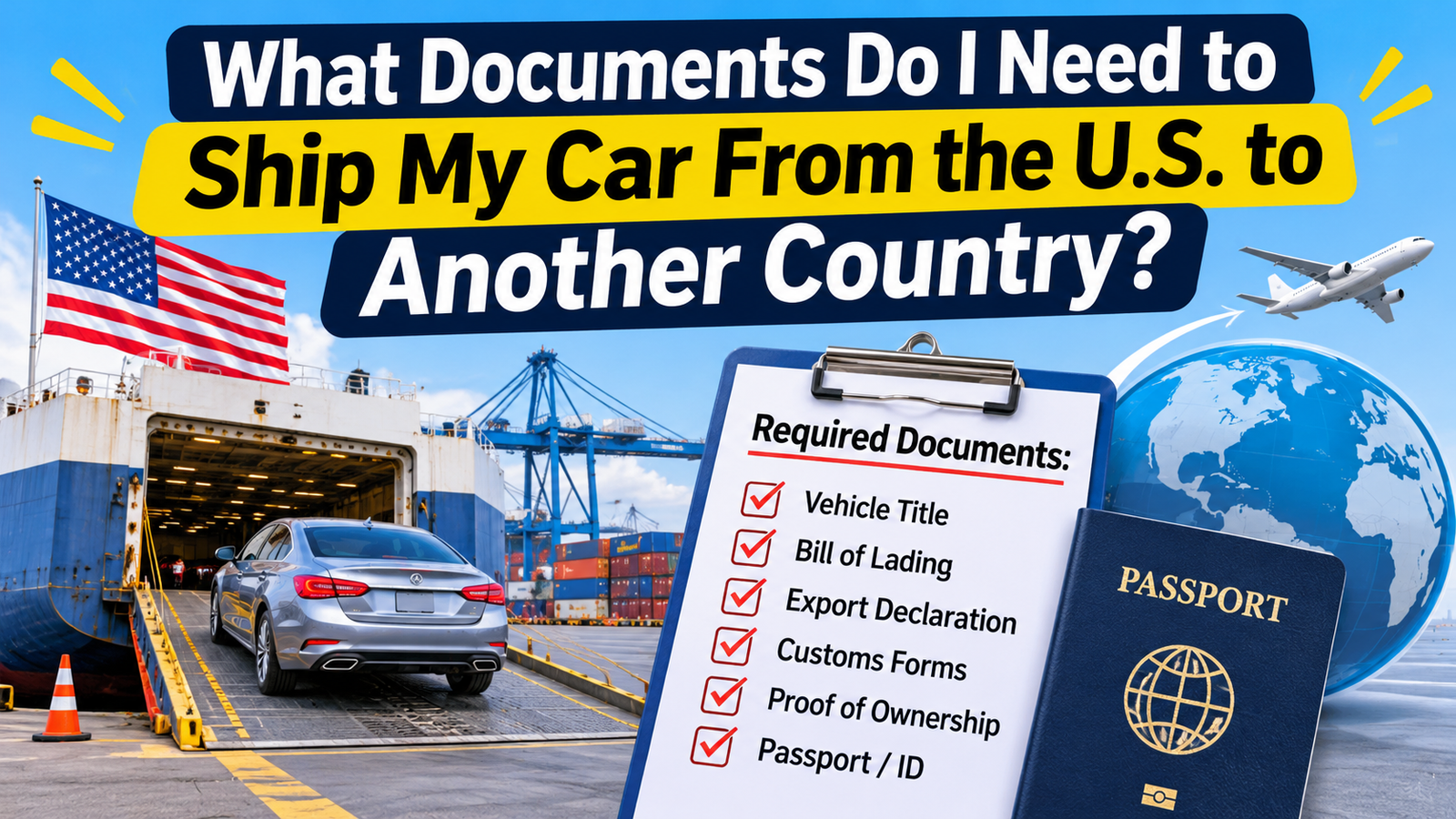
International vehicle shipment is a tedious process that requires transportation arrangements, compliance with export and import regulations, and lots of paperwork. Mistakes in document preparation can cause clearance delays and disrupt shipping schedules. It’s advisable to verify the necessary documents beforehand.
Timely preparation makes the shipping process more efficient, helping you avoid setbacks and complications. This updated November 2026 guide identifies some of the required vehicle shipping documents and provides tips for obtaining them.
Original Certificate of Title
The Certificate of Title is an official document the dealership provides when you buy a car. For pre-owned cars, the seller transfers the existing title. You’ll use it to apply for another title issued in your name from the Department of Motor Vehicles. According to U.S. Customs and Border Protection (CBP), exporters must submit the title certificate at least 72 hours before export.
Why this document matters: It establishes your ownership of the vehicle and prevents the U.S. CBP from exporting stolen vehicles.
Best practices:
- Obtain the original from the Department of Motor Vehicles (DMV) in the state of purchase.
- Make at least two clear photocopies.
Common mistakes to avoid:
- Using a photocopy in place of the original.
- Ignoring an outstanding lien.
Proof of Sale or Valuation
A Proof of Sale confirms vehicle purchase. It can be a Bill of Sale, auction receipt, or dealership invoice. These documents contain transaction details, such as the buyer and seller’s names, purchase date, vehicle description, and selling price. In the absence of proof of sale, you may be able to present a valuation report.
Why this document matters: It clarifies the vehicle’s financial value, allowing customs to identify applicable taxes and import duties.
Best practices:
- Get them from the seller or a licensed appraiser.
- Ensure the seller’s and buyer’s names remain consistent across documents.
Common mistakes to avoid:
- Submitting an unsigned proof of sale.
- Assuming that your proof of sale or valuation replaces the Certificate of Title.
Government-Issued Photo Identification
Acceptable forms of identification include a passport, driver’s license, green and common access cards. Authorities compare the information on it with that on other documents.
Why this document matters: It enables customs, shipping companies, and freight forwarders to verify the owner or exporter’s identity. Hence, it limits identity fraud.
Best practices:
- Use a valid identification document.
- Find out if there’s a preferred form of ID.
Common mistakes to avoid:
- Presenting expired IDs.
- Uploading blurry or cropped copies.
Internal Transaction Number (ITN)
You get an ITN after submitting Electronic Export Information (EEI) to the Census Bureau. When the bureau verifies and accepts the information, the Automated Export System (AES) generates your ITN.
Why this document matters: It proves that the AES has filed and accepted the vehicle’s export information. Customs officers use it to check if the shipment matches the electronic record.
Best practices:
- Keep a copy of your ITN.
- Hire a broker to complete and submit the EEI if you can’t.
Common mistakes to avoid:
- Taking time to file the EEI.
- Failing to correct errors.
Power of Attorney (POA)
With a POA, you authorize a third party to handle specific tasks for you. These may be export, vehicle collection, or transportation procedures.
Why this document matters: It establishes the authority of a representative to perform export or import activities on your behalf.
Best practices:
- Authenticate the document.
- Confirm whether the destination country requires an apostille or embassy legalization.
Common mistakes to avoid:
- Failing to specify the powers delegated.
- Assuming all countries and freight forwarders have the same POA requirements.
If the POA is for the recipient in the other country, you must authenticate it through notarization, an apostille, or embassy legalization. Here are document authentication services you can use:
1. G3 Visas and Passports
Vehicle documents: Provides apostilles for car titles, POAs, and federal documents. Translates and certifies vehicle paperwork.
Pricing: Depends on the destination country, document type, authentication requirements, and timeline.
Features: Has an e-guide, provides online notarization, and authenticates other personal and business documents.
Use cases: Suitable for individuals and businesses that need to validate export documents for official use abroad.
Alternatives: Applying through the U.S. Department of State, the Secretary of State, or the destination country’s embassy.
G3 Visas and Passports is a U.S.-based travel document and authentication service provider. With global trade reaching a record $33 trillion in 2024, vehicle exports are rising, and likewise, the need for document verification. Hence, this agency handles international export document validation.
Pros
- Document tracking
- Remote access
Cons
- Non-refundable policy
- Varied communication consistency
2. Travel Visa Pro
Vehicle documents: Handles apostilles, notarization, state, and federal document legalization for Hague countries and others. Works on car titles, bills of sale, and POAs. Also provides certified translations.
Pricing: Offers basic and premium packages, starting at $99. The quote states the delivery fee.
Features: Has physical offices in major cities. Offers bulk processing, document pre-checks, and expedited service.
Use cases: Legalizing and authenticating vehicle documents in preparation for export.
Alternatives: Direct government application.
From the U.S., Travel Visa Pro assists individuals and dealerships with document translation and legalization. According to its LinkedIn profile, it also handles visa and passport processing for clients. With the U.S. exporting $155.4 billion worth of automotive vehicles, parts, and engines as of 2025, this agency’s processing services foster international transactions.
Pros
- Prompt delivery
- Batch processing for dealerships
Cons
- No preferential government processing
- High markup.
3. Travel Document Systems (TDS)
Vehicle documents: Works with the Secretary of State, United States Department of State, and several embassies and Consulates to legalize export certificates.
Pricing: Charges two separate service fees, government fees, inbound and return shipping fees.
Features: Has human agents, an online order form, and five national offices. Also provides expedited processing, though subject to government delays.
Use cases: Processing legal documents for overseas transactions and getting assistance for authentication.
Alternatives: Sending applications to embassies and government departments.
Travel Document Systems is mainly a visa, passport, and document-processing agency. Its services cover legal and commercial documents, including export certificates for vehicles and other goods. Since the Hague Convention has 130 contracting parties, TDS also facilitates embassy legalization.
Pros
- Corporate account handling
- All-destination processing
Cons
- No notarization
- High cost of processing
4. American Passport and Visa International (APVI)
Vehicle documents: Offers apostille, state authentication, federal authentication, and embassy legalization services for POAs and corporate documents.
Pricing: Starting price for apostilles is $149, and government fees vary by procedure, document type, number, and destination country. It offers expedited tiers with shipping and courier costs billed separately.
Features: Human assistants, an online order form, and support for individuals and businesses across 50 states.
Use cases: Personal and commercial document certification and legalization.
Alternatives: Notaries public, relevant state offices, or embassies.
Located in Washington, DC, American Passport and Visa International operates in several jurisdictions and offers state, federal, and embassy legalization as core document services. With the 2024 U.S. emigrant population being 3.19 million, APVI processes vehicle paperwork to aid property transfers.
Pros
- Unified document processing
- Straightforward website interface
Cons
- Multi-stage processes.
- No direct notarization.
Comparing the Top Document Authentication Providers
Several travel agencies authenticate vehicle documents. However, procedures, requirements, and range of services vary. It’s best to compare their offerings before choosing one. Here is a side-by-side comparison of some exceptional document authentication providers in the U.S.:
| Authenticator Provider | Key Feature | Best For | Limitation |
| G3 Visas and Passports | Personalized concierge assistance | Overseas sale | Restricted online notarization |
| Travel Visa Pro | Nationwide reach | Emergency shipment | Standard processing takes time |
| Travel Document Systems | Secure document upload | Those relocating | Additional fees apply |
| American Passport and Visa International | Multiple authentication options | Those who need guidance | Partial courier assistance |
Conclusion
You now know the essential documents required for an international vehicle shipment from the U.S. Ensure your title certificate, proof of sale, government ID, ITN, and POA are accurate, complete, and meet the destination country’s requirements. When authenticating these documents, consider service, speed, and pricing to pick a provider that supports your needs.
Next Steps
- Confirm requirements from the relevant U.S. Customs and Border Protection (CBP) port.
- Check your vehicle to ensure it meets the destination country’s eligibility requirements.
- Gather the necessary documents and make photocopies.
- Find out if they need notarization, an apostille, embassy legalization, or certified translation.
- Compare authentication providers based on their service offerings and reliability.
FAQ
Are original documents or photocopies required when submitting vehicle shipping paperwork?
U.S. Customs and Border Protection (CBP) generally requires the original vehicle title and two complete copies for export verification. For other documents, you can submit photocopies.
Can I ship a car from the U.S. if the vehicle title is not in my name
Yes, but the requirements differ, as you’ll need additional documentation to prove your authority to export it. Depending on the circumstances, you’ll need to provide a lien release letter, proof of inheritance, a bill of sale, or other documents.
How long will it take to ship my car?
On average, it can take about two to eight weeks. The time frame depends on the destination country and shipping method. Air freight is much faster than roll-on/roll-off and container shipping, but it costs more.





Add comment