
Now people are going to use different apps, platforms and productivity tools in this digital world. Reports of working time, screen activity, engagement, performance, sleep, fitness or any other measurable habit can be generated by these tools. One of the terms you may come across is called My Best Hours Report.
A My Best Hours Report generally provides users with insight into when their activity, speed or performance is strongest during a day. More importantly to know is that “My Best Hours Report” is not a single universal report with one single definition. The features, calculations and data a report offers you for analysis are determined by the platform or application where it is being fed.
In this article, I will show you what a My Best Hours Report can (and cannot) mean, how they generally work and may look – including the types of information they might contain; as well as how you could possibly leverage those results to hack your daily routine.
What Is My Best Hours Report?
A My Best Hours Report is a data-significant summary distinguishing the hours or time spans when other individuals are most active, productive, engaged, or performing at their best.
As a concrete example, suppose you have some productivity app that logs when you accomplish tasks. As more data is collected, it will detect patterns in the application as:
- You get most of your day work done from 09:00 to 12:00.
- You are less active in the afternoon.
- You resume your activity after dark.
- Some days tend to have distinctive productivity habits.
The system will describe your most productive time as your best hours, based on this data.
The data used may vary widely. For example, a productivity platform may analyze done tasks and fitness application workout performance. For example, a social or communications platform may have the notion of ‘best hours’ defined in terms of audience engagement or user activity.
So you should always check to see the definitions and methodology of what the specific service generating the report used.
Read More: QuillBot AI || TheBloxstrap com
Why Are My Best Hours Reports Useful?
Knowing when you are most productive or best working period / activity time can be used to schedule your time better. You might feel like you should be whizzing through work daily, but everyone’s routines and performance times are different;
An activity based report that looks back at your actual recorded activity might be a good way to really pick up on these patterns.
Some possible benefits include:
1. Better Time Management
If you notice that your potential productivity goes up during certain hours in your report, it might make sense to schedule important tasks for those times.
E.g. Your highest concentration level in the morning so book that time for:
- Writing
- Research
- Planning
- Problem-solving
- Studying
- Important professional tasks
The less taxing tasks could then be scheduled for when you have lower energy or focus.
Understand
2. Understanding Personal Patterns
People often have different routines. Some are productive in the early hours of the day and others might be more active in later hours of the day.
A My Best Hours Report, which provides weekly statistics and insights on a particular rhythm or metric you choose, can further assist you in changing vague impressions into measurable patterns. Rather than just stating that, “I think I work better in the morning,” you might have access to historical activity data tracked over a longer period.
3. Improved Scheduling
Once you identify recurring patterns, you can experiment with scheduling your day around them.
For instance:
| Time Period | Possible Activity |
| Best Hours | Important or high-focus tasks |
| Moderate Hours | Meetings and routine work |
| Lower Activity Hours | Administrative or simple tasks |
This is only a general example. The right schedule depends on your personal responsibilities and the type of information included in the report.
How Does My Best Hours Report Work?
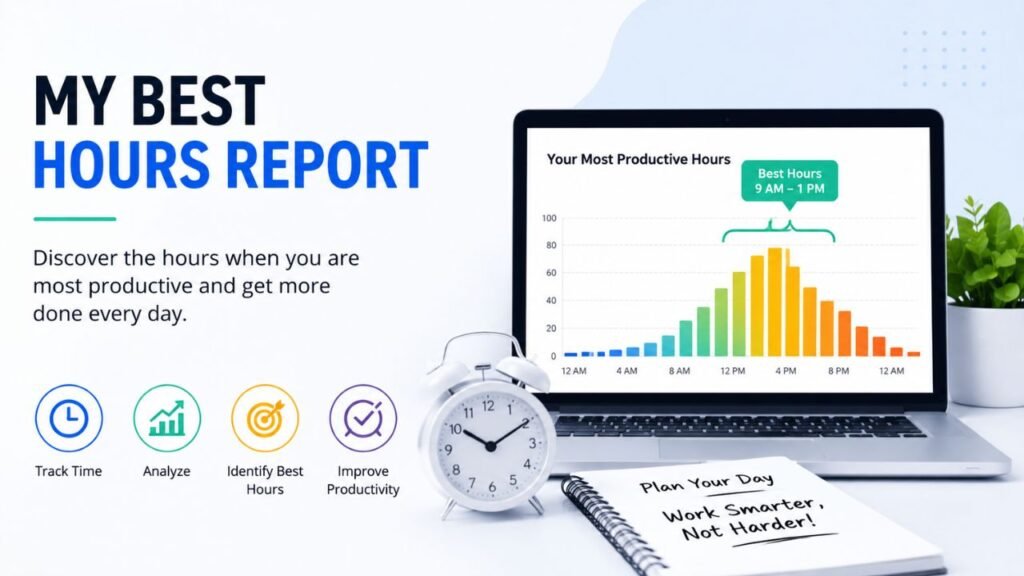
Generally, this actually varies from platform to platform. Although numerous reports are based on data, they often go through a structure quite like this.
Step 1: Data Collection
Keep track of the activity that is relevant in time. This information will vary depending on the service:
- Time spent working
- Completed tasks
- User interactions
- Website or app activity
- Exercise performance
- Sleep-related information
- Audience engagement
- Login or usage patterns
The data type collected depends completely on the platform and its privacy settings.
Step 2: Pattern Analysis
Once there is enough data, the system may compare activity on a per-hour and per-day basis.
For instance, if someone completes more tasks between 10 AM to 1 PM than at an earlier or later time, those hours will be assigned a higher productivity score – similar to when you are at your job and keeping track of how many people come in during different times.
Step 3: Report Generation
After this, the platform displays the results in some sort of report or chart, timeline or summary.
The report might highlight:
- Most active hours
- Most productive periods
- Peak performance times
- Low-activity periods
- Daily patterns
- Weekly comparisons
And in some cases, services may allow users to compare different days or date ranges.
Information That May Appear in the Report
The content of a My Best Hours Report can vary, but users may find several common types of information.
Peak Activity Hours
This section highlights when the recorded activity was highest.
For instance, your report may state that you were most active between 8 AM and 11 AM.
Take note that activity does not translate to quality work. Just because you had a busy hour, with many interactions does not mean it was your most focused or effective hour.
Productivity Trends
Certain platforms may also benchmark the performance across different periods.
For example:
- Morning productivity
- Afternoon productivity
- Evening activity
- Weekday patterns
- Weekend patterns
They also have some trends that will allow the users to know if they stay on their routine.
Read More: Cutout Pro || GetTransMac Com
Daily or Weekly Comparison
One of possible reports could compare the day with another day.
You may notice that:
- Mondays are more productive.
- Midweek activity is highest.
- Weekend schedules are different.
- Productivity changes based on workload.
Although tracking over a sustained period can give you valuable insights, only so much can happen in one day.
Performance History
There are some tools that let you go through past data. This is helpful because it helps determine if excitement (routine change) decreases performance or not.
For example, you might compare:
- One month with another
- Clean out your closet before and after adjusting the work hours
- Different project periods
- Different days of the week
How to Check Your My Best Hours Report
How to connect, however, depends on the platform you are connecting from. In general terms, this is how you can proceed:
- Login app or website.
- Access the dashboard, reports, analytics or insights section
- Search for activity, productivity, performance or best hours features.
- Select the available date range.
- Take a look at the data and trends shown.
- Look for a clear explanation of how the results are generated.
If you cannot find the report, visit the help center or support documentation of the specific platform. Identifiers and navigability can change through software updates.
How to Use the Report Effectively
Simply viewing your best hours is not enough. The real value comes from using the information carefully.
Schedule Important Work During Peak Hours
If your report has consistently identified particular hours as highly productive then they should be used for activities that require deeper concentration.
Examples include:
- Writing articles
- Preparing presentations
- Learning new skills
- Strategic planning
- Data analysis
- Creative work
Do not assume though that one report is going to be eternally accurate. Personal routines can change.
Track Patterns Over a Longer Period
A single day may not accurately represent your usual behavior. Your performance can be affected by:
- Sleep
- Workload
- Travel
- Meetings
- Personal schedules
- Deadlines
- Holidays
Reviewing trends over several weeks may provide a better understanding of recurring patterns.
Avoid Overinterpreting the Data
Reports are an excellent tool, but they do not explain all the reasons for your performance.
An afternoon full of meetings can lead to a reduction in productivity and not just a natural decline of focus. Conversely, an unusual deadline can lead to a high-activity period.
Take the report as an insight, not something written in stone.
Experiment With Your Schedule
When you find a pattern – test it.
For example, if your best hours seem like they are between 9 AM and noon then plan to do important work in that time period for a number of weeks. Then compare your results.
That said, this method helps you assess whether the pattern is a true asset of your routine.
Important Things to Remember
Before relying heavily on a My Best Hours Report, keep these points in mind.
The Definition Depends on the Platform
Different platforms measure different activities. Assigned by task (30% completed), engagement, online activity or performance metrics e.g. best hours for one app may be used by another
Always check out the explanation provided by the platform before reading into the results.
More Data Can Produce Better Insights
Limited activity may lead to an inaccurate reflection of your normal regime in the report. More meaningful patterns may be derived from tracking consistently over time.
Activity Is Not Always Productivity
Just because you are busy does not mean you are productive. Doing ten little things will not be better than spending an hour to finish an important project.
Count and quality when you evaluate your results.
Your Best Hours Can Change
Depending on a new job, study schedule, season, workload or lifestyle changes your rhythm might be affected. This is why it helps to check for updated reports from time to time.
Privacy and Data Considerations
If an application creates a My Best Hours Report, it may need to collect and process information about your activity. Before enabling detailed tracking, review:
- The platform’s privacy policy
- The type of data collected
- How long data is stored
- Whether you can delete your information
- Available privacy controls
Only provide permissions that you are comfortable sharing.
Common Problems With My Best Hours Reports
Sometimes users may not see a report or may find that the results appear incomplete.
Possible reasons include:
Insufficient Data
The service might need a little bit of activity before it can spot anything meaningful.
Tracking Is Disabled
This report may not have sufficient data when the activity tracking or analytics permission is turned off.
Incorrect Date Range
Verify that the chosen date range is not missing info
Software Changes
Applications regularly update their features. A report can also be renamed, relocated, modified, or deleted.
Different Account or Device
Ensure that you are looking at the same account where that activity has been tracked.
Read More: CareerWill Login || killMetrix Knowledg || Nai Taiyari.com
FAQ’s
What is My Best Hours Report?
A My Best Hours Report generally identifies the periods when your recorded activity, productivity, engagement, or performance is highest. Its exact meaning depends on the platform providing it.
How are best hours calculated?
The calculation depends on the application. It may analyze completed tasks, usage activity, engagement, performance data, or other metrics.
Are my best hours always the same?
No. Your activity patterns can change over time because of schedule changes, workload, sleep, and other factors.
Does high activity mean high productivity?
Not necessarily. High activity measures may show that you were busy, but the quality and importance of the work should also be considered.
Why is my My Best Hours Report not available?
Possible reasons include insufficient data, disabled tracking, account issues, software changes, or the feature not being available for your account or plan.
Can I improve my productivity using the report?
You can use the report to identify possible patterns and experiment with scheduling important tasks during your strongest periods.
Conclusion
You can use the report to identify possible patterns and experiment with scheduling important tasks during your strongest periods.
A My Best Hours Report is a great way to see when you get the most done. These reports, which parse out recorded activity, may pick up changes that will be easy to miss in the context of a hectic day-to-day routine.
There is not one specific definition of a My Best Hours Report that applies universally. The exact information, calculations and features will depend on the specific app, website or service you use. Always refer to the official data source of your reports for accurate interpretation.
The ideal would be to use the data as a guide rather than a rule. Look at your review patterns over time, evaluate the quality of your work, and play around with when you schedule it. In other words, if used wisely, a My Best Hours Report can help you learn more about your own routine and use that information to make better use of how you manage everything with time.







Add comment